

Employee recognition in a small or medium business doesn't need a big budget or a software platform. It needs a few good habits: notice good work, say thank you specifically and soon, and mark the milestones that matter. This guide shows Australian businesses with roughly 5 to 200 people how to set that up, what it costs and what to check at tax time.
Why does recognition matter more in a smaller business?
In a team of 15 or 50, everyone carries a bigger share of the work, so every resignation is felt. There's no large team to absorb a vacancy, and the cost of hiring and training someone new lands straight on the owner or manager.
Smaller businesses also have a real advantage: leaders actually know their people. A thank-you from the owner or a manager who saw the work means far more than an automated badge from head office. A recognition plan simply makes sure that advantage is used every time, not only when someone remembers.
What contributions should you recognise?
Recognise the contributions that keep your business running, not just the big wins. It helps to think in three levels:
- Everyday effort: covering a shift, helping a colleague, handling a difficult customer well, fixing something nobody asked them to fix.
- Achievements: finishing a project, winning a client, passing probation, completing a qualification, a strong safety record.
- Milestones: work anniversaries (commonly 1, 5, 10, 15, 20 and 25 years) and retirement.
Ask your team what they'd like noticed more. In most small businesses, the answer is the quiet, behind-the-scenes work that keeps customers happy.
How do you build a simple recognition plan?
You can set up a plan that works in an afternoon. These five steps suit most small and medium businesses.
- Write down what you value. Pick three to five behaviours that matter in your business, such as looking after customers, safety, teamwork or reliability. These become your reasons for recognising people.
- Decide who recognises. In a business under 20 people, that's usually the owner and team leaders. As you grow, make every manager responsible for their own team and give colleagues an easy way to thank each other.
- Set a rhythm. Thank-yous happen in the moment. Achievements are acknowledged within the week. Milestones are planned ahead, using the start dates you already have in payroll.
- Match the reward to the moment. A personal note for everyday effort, a small gift for an achievement, and a meaningful gift with a memento for a service milestone.
- Put it in the calendar. Add work anniversaries and probation dates to a shared calendar so nobody is missed. A forgotten milestone can do more harm than no recognition at all.
How much should a small business spend on recognition?
There's no single right number, but it's easier to budget by type of recognition than as one lump sum.
- Everyday thanks costs time, not money. A specific, personal thank-you from a manager is often what people value most.
- Achievements and small wins suit a modest gift, a team lunch or a gift box, bought as moments come up.
- Service milestones are where most of the budget goes. Set a value for each milestone and step it up with years of service, so a 10-year award feels clearly bigger than a 5-year one.
Start by counting how many people reach a milestone in the next 12 months. That number, plus a rough allowance for achievements, gives you a realistic annual budget. Our guide on how much to budget for long service awards covers milestone values in more detail.
Do employee gifts attract fringe benefits tax?
Some do and some don't, so it's worth checking before you choose. Under the ATO's minor benefits exemption, a gift worth less than $300 (including GST), given infrequently and irregularly, is generally exempt from fringe benefits tax. Gift cards and vouchers can qualify too. Cash bonuses are treated differently and are generally taxed as salary.
Higher-value gifts, such as long service awards, have their own considerations. Because FBT depends on your circumstances, check with your accountant before you set up a program. This is general information only, not tax advice.
What are some low-cost recognition ideas that work?
- A handwritten note from the owner or manager that names exactly what the person did.
- A shout-out in the team meeting or group chat, with the reason, not just a quick "well done".
- Passing positive customer feedback on to the person it's about, with their manager copied in.
- An early finish or a long lunch after a busy period.
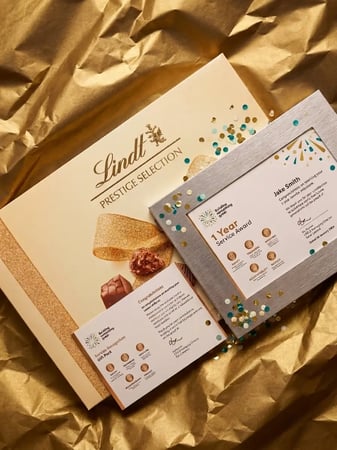
- A gift box with a personalised certificate for passing probation or a first work anniversary.
- Asking someone to show others how they do something well.
What does a recognition plan look like in practice?
A 15-person business: the owner keeps a list of start dates and gives a personal note and gift on each work anniversary. Team leaders give at least one specific thank-you to each person every week. Big wins are mentioned at the monthly team meeting.
A 120-person business: every manager is responsible for recognising their team, with a one-page guide on what to recognise. A simple peer-to-peer tool lets colleagues thank each other. Service milestones from five years are handled through a long service program, with a gift the employee chooses, an engraved memento and a presentation.
How do you know if recognition is working?
Keep it simple. Watch staff turnover and how long new starters stay. Ask a recognition question in your staff survey or one-on-ones, such as "Do you feel your work is noticed?" And check that milestones are being marked on time. If people are leaving in their first year, start by looking at how you recognise probation and first anniversaries.
Frequently asked questions
Is employee recognition worth it for a business with fewer than 20 staff?
Yes. In a small team, losing one person has a big effect on workload and customers. Consistent, personal recognition is one of the lowest-cost ways to help people feel valued and want to stay.
Should we give gift cards or gifts?
Gift cards are simple, but they're easily spent on everyday items and forgotten. A gift the person chooses, presented with a certificate or memento, tends to be remembered for much longer. Many businesses use gift cards for small wins and chosen gifts for milestones. Read more about gift cards versus gifts.
Do we need recognition software?
Not to start with. A calendar of milestones and managers who say thank you consistently will cover most small businesses. Software becomes useful once you have several teams or locations and want colleagues to recognise each other.
Which work anniversaries should we recognise?
Many Australian businesses recognise 5, 10, 15, 20 and 25 years and beyond. Recognising probation and the first anniversary as well helps new starters feel part of the team early.
Need a hand?
HW Holdsworth helps Australian organisations of every size recognise their people, from chocolate recognition packs for the small wins to long service recognition for the big milestones. Talk to our team about what would suit your business.